Group Theory and Symmetry
SECTION 01
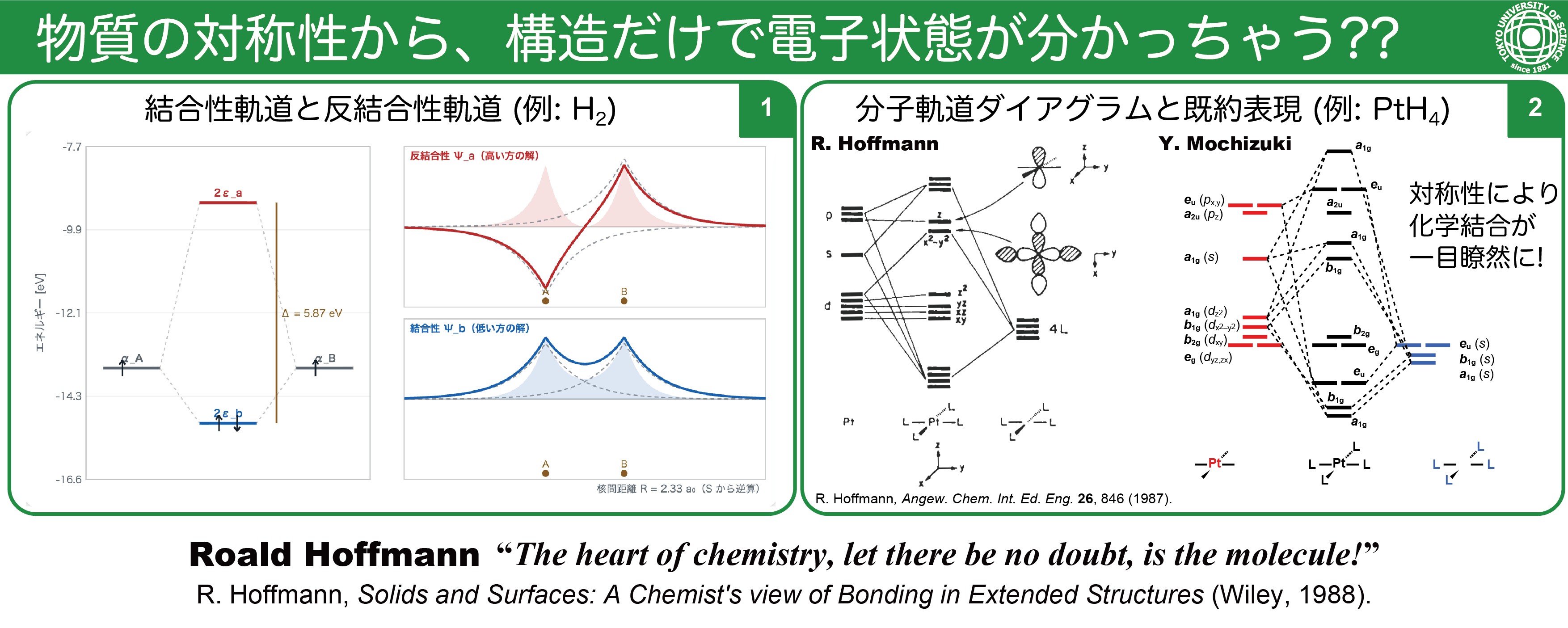
Our symmetry analysis package CrystOD (Crystal Orbital Diagram)
automatically generates molecular orbital diagrams based on group theory to help explain chemical bonding in molecules and crystals in terms of symmetry and orbital interactions.
For crystals, a single command can generate symmetry-adapted linear combinations (SALCs) using space-group irreducible representations, label crystal orbitals, enumerate isotropy subgroups, and derive phonon irreducible representations and symmetry-adapted subgroup structures.
Install the package with pip install crystod; usage instructions are available in the CrystOD documentation.
The example below shows a molecular orbital diagram for C6H6 with D6h symmetry, visualizing energy levels and wave functions using PySCF calculations and symmetry analysis.
The same approach can be applied to crystals. Using only a crystal structure (POSCAR) as input, qualitative crystal orbital diagrams can be drawn with the extended Hückel approximation, without quantum chemistry calculations. The example below shows ScF3 (Pm-3m). Bloch orbitals of the Sc and F3 sublattices (left and right columns) that belong to the same irreducible representation of the little group hybridize to form bonding and antibonding crystal orbitals (center column). Use the buttons at the top to switch between k-points (Γ, R, X, M). Click an energy level to view its composition and wave function Re[ψ].
You can also view the symmetry-adapted linear combinations (SALCs) themselves, again using only a crystal structure (POSCAR) as input. The example below shows SALCs formed from Ni 3d orbitals in La3Ni2O7 (I4/mmm) at the X point (0, 0, 1/2). Explore the basis functions in three dimensions within the conventional unit cell, classified by irreducible representation.