
Theoretical background#
This page collects the group theory that CrystOD evaluates internally: the
representation matrices of the symmetry operations, the characters that reduce
them to irreducible representations, and the projection operator that turns an
irrep into an actual symmetry-adapted function. None of it has a command-line
flag — it is the shared basis of crystod, crystod-group and crystod-mag,
and it is what the output labels of those commands mean.
Example directory: example/01_wigner_d (testsuite section 1)
Note
This section is theoretical background, not a command-line mode: there is
no CLI flag for it. Everything described here is what CrystOD evaluates
internally every time one of the commands is executed; the machinery is exposed
through the Python API only (crystod.operations.wigner_D_real). No prior
familiarity with group theory is assumed.
What is a representation matrix?#
Take a symmetry operation of a crystal — say a 90-degree rotation about the z
axis, C4z (x -> y, y -> -x, z -> z). Apply it to the three p orbitals, which
have the same shapes as the functions x, y, z:
p_x -> p_y, p_y -> -p_x, p_z -> p_z.
Each orbital turns into a linear combination of the orbitals of the same
shell. Collecting the coefficients into a matrix gives the representation
matrix D(R) of the operation on that shell. For p orbitals it is simply the
3x3 rotation matrix itself:
D^(1)(C4z) =  [ 0 -1  0 ]      (basis order: x, y, z)
              [ 1  0  0 ]
              [ 0  0  1 ]
For d orbitals the same idea gives a 5x5 matrix. Under C4z:
xy -> -xy, yz -> -xz, z^2 -> z^2, xz -> yz, x^2-y^2 -> -(x^2-y^2), so
D^(2)(C4z) =  [-1  0  0  0  0 ]      (basis order: xy, yz, z^2, xz, x^2-y^2)
              [ 0  0  0 -1  0 ]
              [ 0  0  1  0  0 ]
              [ 0  1  0  0  0 ]
              [ 0  0  0  0 -1 ]
These matrices for the orbital shells (any l) are the Wigner D matrices
on real spherical harmonics. crystod.operations.wigner_D_real(l, R) returns
them for an arbitrary O(3) operation R (rotation, rotoinversion, or mirror):
import numpy as np
from crystod.operations import wigner_D_real

c4z = np.array([[0.0, -1.0, 0.0], [1.0, 0.0, 0.0], [0.0, 0.0, 1.0]])

wigner_D_real(1, c4z)           # l = 1 (p): equals the 3x3 rotation matrix itself
wigner_D_real(2, c4z)           # l = 2 (d): the 5x5 matrix above
np.trace(wigner_D_real(2, c4z)) # character of C4z on the d shell: -1
wigner_D_real(3, -np.eye(3))    # inversion: (-1)^l x identity (parity), here -1 x 1(7)
Key properties (verified in testsuite section 1):
for proper rotations at
l= 1 the matrix equalsRitself;inversion is represented by
(-1)^ltimes the identity — even shells (s, d, …) are unchanged, odd shells (p, f, …) flip sign (the parity of the orbital);the map is a group homomorphism,
D(AB) = D(A) D(B)— performing two operations in sequence is the same as multiplying their matrices;all matrices are orthogonal,
D D^T = 1.
How CrystOD computes D for any l#
Rotation matrices act directly on (x, y, z), so l = 1 is trivial — but how do
we get the 5x5, 7x7, … matrices for d, f, … shells without working out every
monomial by hand? CrystOD follows the classic quantum-mechanics route
(prototyped in matsym/wigner_d.ipynb by Hiroki Koiso):
Split off the inversion. Any O(3) operation is a proper rotation times (possibly) the inversion:
R = det(R) x R_proper. Work with the proper rotationR_proper = det(R) Rfirst.Convert the rotation to Euler angles (alpha, beta, gamma) in the ZYZ convention.
Evaluate Wigner’s formula for the complex D matrix
D^(l)(alpha, beta, gamma)— the standard result for how the complex spherical harmonicsY_l^m(m = -l..l) transform under rotations. This works for any l.Change basis from complex to real orbitals. The real orbitals are fixed linear combinations of
Y_l^m(e.g.p_x = (Y_1^-1 - Y_1^1)/sqrt(2)), so a unitary matrixCconverts the complex D matrix to the real-orbital one:D_real = C D_complex C^-1.Restore the parity. If the original operation was improper (
det(R) = -1), multiply by the inversion eigenvalue(-1)^l.
The production implementation in crystod/operations.py performs these steps
in pure NumPy (no symbolic algebra), with the orbital ordering
p: (x, y, z) / d: (xy, yz, z^2, xz, x^2-y^2) / f: (7 components).
From matrices to irreps: characters and the reduction formula#
The trace of a representation matrix, chi(R) = tr D(R), is called the
character of the operation. Characters are the workhorse of applied group
theory because they do not depend on the basis choice, and because tabulated
character tables list the characters chi_Gamma(R) of each irreducible
representation (irrep) Gamma — the elementary building blocks into which any
representation decomposes. The number of times an irrep appears is given by the
reduction formula
n_Gamma = (1/|G|) * sum_g chi_Gamma(g)* chi(g),
an average over all |G| operations of the group. This is exactly how the
ligand-field splitting of crystod-group --ligand-field (section 9) works:
the characters of the d shell in the
m-3m field, chi(g) = tr D^(2)(g), reduce to Eg + T2g — the familiar
two-below-three splitting of d orbitals in an octahedral crystal field.
In a crystal, a space-group operation g = {R | t} does two things to an
atomic orbital: it moves the atom to a symmetry-equivalent site, and it mixes
the orbital components on that site with D^(l)(R). The character of the
crystal-orbital representation at a k point is therefore the trace of
D^(l)(R) summed over the atoms that g maps onto themselves (modulo a
lattice translation), weighted by the Bloch phase exp(-ik.t) of that
translation. Reducing these characters against the little-group irrep table
gives the irrep content printed by the SALC analysis and the crystal-orbital
diagrams of crystod (sections 2-3).
From irreps to basis functions: the projection operator#
Knowing how many times an irrep appears is half the story; the other half is what the symmetry-adapted functions look like. They are extracted with the projection operator
P^(Gamma) = (d_Gamma/|G|) * sum_g chi_Gamma(g)* O(g),
where O(g) is the representation matrix of g on some convenient trial basis
and d_Gamma is the irrep dimension. Applied to a trial function, P^(Gamma)
kills every component except the part transforming as Gamma.
The workflow — prototyped in matsym/get_basis_functions.ipynb by Hiroki
Koiso — is the engine of crystod-group --basis / --generate-basis
(sections 10-11 of crystod-group):
get the symmetry operations from spglib and the irreps from spgrep;
build the representation matrices
O(g)of the trial basis — for the linear monomials (x, y, z) these are the rotation matrices themselves; for the quadratic monomials (x^2, y^2, z^2, xy, yz, zx) a 6x6 matrix follows from substituting the rotated coordinates into each monomial, and so on;project with
P^(Gamma)(spgrep’sproject_to_irrep) and read off the symmetry-adapted polynomials — e.g. in m-3m the quadratic monomials separate intox^2+y^2+z^2(A1g),(2z^2-x^2-y^2, x^2-y^2)(Eg), and(xy, yz, zx)(T2g).
It is worth looking at the matrices of step 2 before projecting. The two
galleries below (regenerated from the notebook by
doc/make_rep_matrix_figures.py) show O(g) for all 48 operations of the
Pm-3m point group of ScF3 at the Gamma point — one small panel per operation,
with red = +1, blue = -1, white = 0.
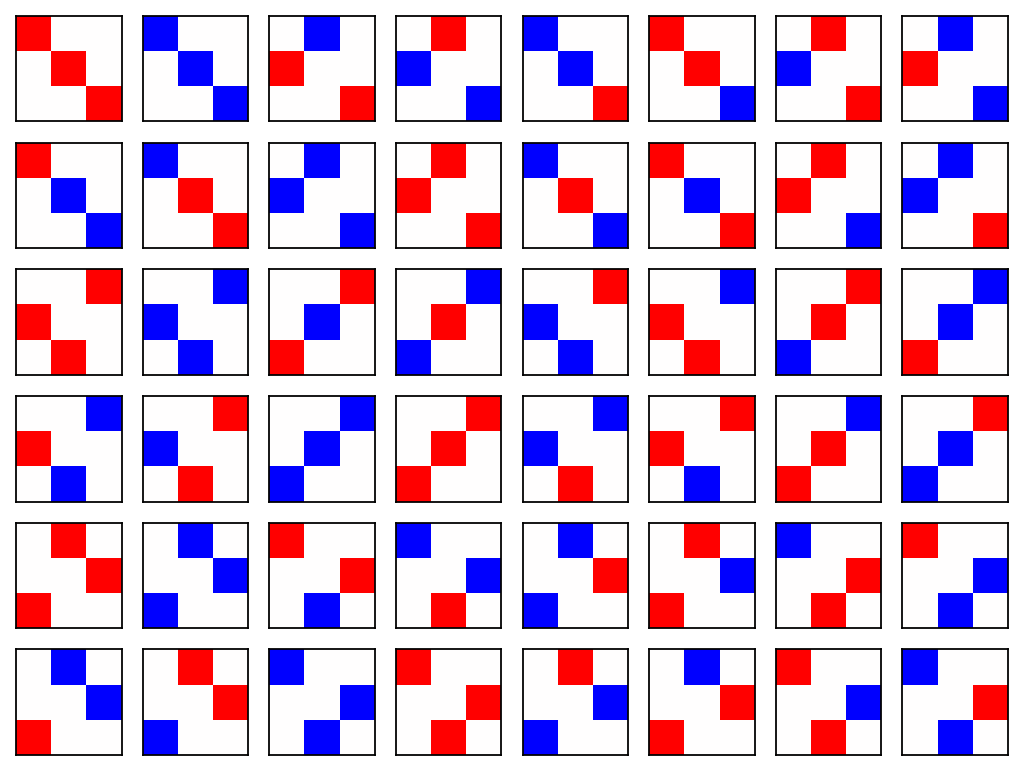
The 48 representation matrices on the linear basis (x, y, z) — i.e. the 3x3 rotation matrices themselves. Red = +1, blue = -1, white = 0.#
Two things are immediately visible. First, every panel has exactly one colored cell per row and per column: for a high-symmetry (cubic) group the operations do nothing more exotic than permute the basis functions and flip signs — these are signed permutation matrices (the first panel, the identity, is the plain red diagonal). Second, no single monomial stays put in every panel, which is the visual way of saying that x, y, z individually are not symmetry-adapted: they mix, and only the projection operator can disentangle the combinations that transform cleanly.
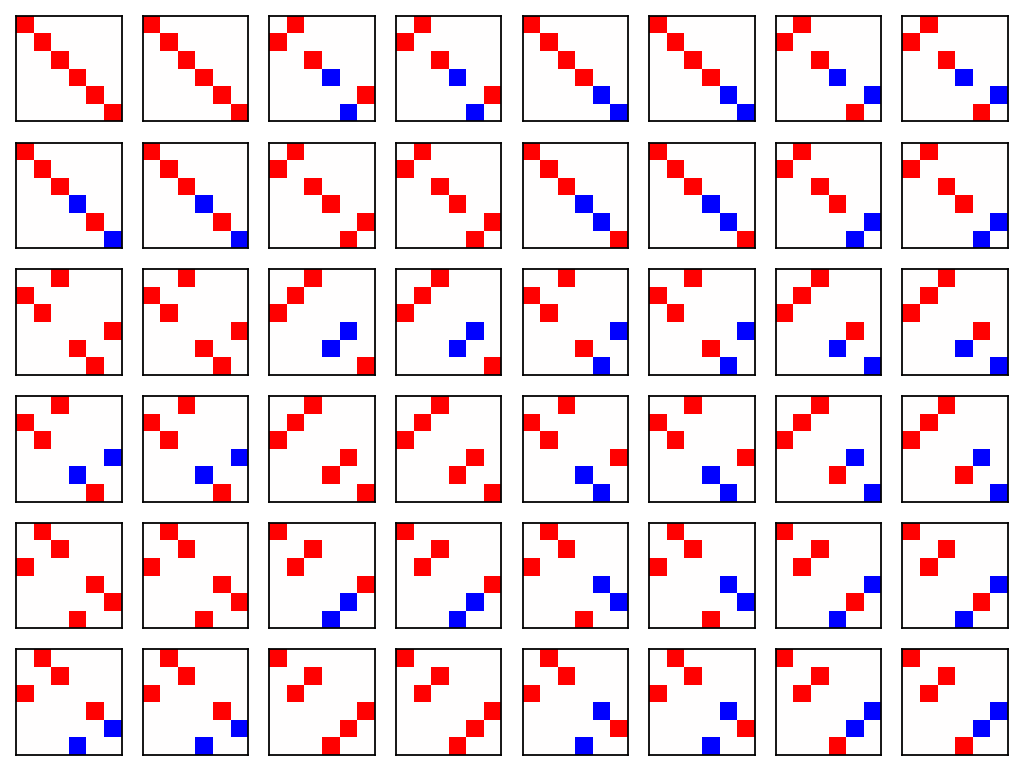
The same 48 operations on the quadratic basis (x^2, y^2, z^2, xy, yz, zx) — now 6x6 signed permutation matrices.#
The quadratic gallery shows one more feature: a block structure. The
upper-left 3x3 block (x^2, y^2, z^2) and the lower-right 3x3 block
(xy, yz, zx) never mix — a rotation can turn x^2 into y^2, or xy into -yz, but
never a square into a product. Note also that the squares block is always
red: a square can never acquire a minus sign, which is why the totally
symmetric average x^2+y^2+z^2 (A1g) survives. The projection operator is
nothing but a weighted average of these 48 panels — multiply each panel by the
irrep character chi_Gamma(g)* and sum — and the block structure you see here
is exactly what reappears in the result: the squares block yields
A1g + Eg, the products block yields T2g, reproducing step 3 above (and the
crystod-group --generate-basis --order 2 output of section 11 of
crystod-group).
The SALCs of the main crystod command and of its SALC viewer (section 5 of
crystod) come from the same projection with
the trial basis replaced by the atomic orbitals on all symmetry-equivalent
sites — O(g) then combines the site permutation, the Bloch phases, and
D^(l)(R) from section 1.2 above. And replacing D^(1)(R) = R by the
axial-vector
representation det(R) R (magnetic moments do not flip under inversion) turns
the same machinery into the spin-multipole bases of crystod-mag (section 28).
Further reading: B. Souvignier, “Representations of crystallographic groups”
(MaThCryst summer school notes, Nancy 2010);
the spgrep documentation, e.g. the
symmetry-adapted tensor example.
Run python demo_wigner_d.py in example/01_wigner_d for a printed walk-through.
Multi-electron terms: symmetrized products and the Pauli principle#
Coulomb multiplet energies: Gaunt coefficients, Racah parameters and configuration interaction#
The two-electron integrals behind the multiplet energies of
crystod-group --multiplet --orbital (section 14 of the crystod-group
page) are built from exact Gaunt coefficients (F^0 = A + 7C/5,
F^2 = 49B + 7C, F^4 = 63C/5), the Coulomb Hamiltonian over the Slater
determinants of the configuration, and each term is isolated by S^2 and
point-group projectors; doubly-occurring terms mix (configuration
interaction) and their two energies are printed in closed form
(e.g. 3A - 3B + 3C +- 3sqrt(2)B in (t2g)^2(eg)^1). Every run is closed by
the trace identity sum (2S+1) dim E = tr(H_ee); the free-ion limit is
reproduced exactly ((T1u)^2 with –orbital p gives ^3P = F0 - 5F2,
^1D = F0 + F2, ^1S = F0 + 10F2).
The Pauli principle in multi-electron terms: antisymmetrized squares and CI matrices#
Of the plain direct product T2g x T2g = A1g + Eg + T1g + T2g (as printed by
crystod-group --product, section 7 of the crystod-group page), the Pauli
principle pairs only the antisymmetric square (T1g) with the spin
triplet — crystod-group --multiplet performs this antisymmetrization
exactly, for any filling of any shell (hole equivalence and closed shells come out
automatically: (t2g)^4 gives the (t2g)^2 terms, (t2g)^6 gives ^1A1g).
Validated against the standard crystal-field term tables (t2g^n, eg^n,
t2g^2 eg^1 in Oh; e^2 in Td and C3v).
For two-shell configurations, the doubly-occurring terms (the CI pairs) are additionally printed as their CI matrix in the coupled-parent basis |shell1(S1 Gamma1) shell2(S2 Gamma2)> — the representation used by the Tanabe-Sugano/Griffith strong-field tables — e.g. for (t2g)^2(eg)^1: the ^2Eg block is <t2g^2(^1A1g)eg|H|…> = 3A + 8B + 6C, <t2g^2(^1Eg)eg|H|…> = 3A - B + 3C, off-diagonal ±10B, whose eigenvalues are exactly the printed 3A + (7/2)B + (9/2)C ± (1/2)√(481B² + 54BC + 9C²) (the off-diagonal sign is a basis convention; books may differ).