Chapter 30Free Energies — Direction of Change and Maximum Work
Ice floating in hot water melts into water on its own. A hot frying pan cools on its own until it reaches the same temperature as the surrounding air. Both are changes that naturally proceed in only “one direction,” and the reverse direction—water turning into ice on its own in a room warmer than $0\ ^\circ\mathrm{C}$ and warming its surroundings, or a cold frying pan heating up on its own—never occurs. In the previous chapter (Chapter 29) we defined the entropy $S$ as the state quantity that quantifies this “direction,” and we confirmed that in an isolated system (a system that exchanges no heat at all with its surroundings) $\dd S\ge0$ holds (the law of entropy increase), and that the adiabatic free expansion of an ideal gas gives $\Delta S\gt0$ and is therefore a spontaneous change.
However, the systems we ordinarily handle in the laboratory or the factory are usually not isolated. A reaction in a beaker proceeds while exchanging heat and volume with the surrounding air (atmospheric pressure) and with the laboratory bench (a thermostatic bath at constant temperature). To decide the direction of spontaneous change in such a “system that exchanges heat with its surroundings,” we cannot use $\dd S\ge0$ as it stands—if we looked only at the entropy of the system, we would be ignoring the entropy change of the surroundings. In this chapter we first apply the Clausius inequality $\dd S\ge \dd'Q/T$ of the previous chapter to the concrete questions “In which direction does heat flow?” and “How does the entropy change with a phase transition or a temperature change?” We then rewrite the Clausius inequality in terms of quantities of the system alone for the two conditions most commonly encountered in the laboratory—constant volume and temperature and constant pressure and temperature. What emerges are two new state quantities, the Helmholtz free energy $A$ and the Gibbs energy (Gibbs free energy) $G$; they are very convenient tools that express “the combined effect of the entropy of the system and the entropy of the surroundings” in terms of variables of the system alone.
In the second half we show that the changes in $A,G$ are equal to the maximum work that can be extracted from the system in a reversible change. When we consider how much work a battery or a fuel cell can deliver, or how much “useful work” a chemical reaction can produce, it is precisely $A,G$ that play the leading role. Finally, we derive the temperature dependence of the Gibbs energy and the Gibbs–Helmholtz equation, which is used frequently in chemical thermodynamics. Note that the two topics of the Clausius equality and the adiabatic free expansion of an ideal gas were already treated in the previous chapter (Section 29.7 and Section 29.8), so at the beginning of this chapter we only briefly recall their conclusions.
- Derive from the Clausius inequality $\dd S\ge \dd'Q/T$ that heat moves spontaneously from high temperature to low temperature, and learn the entropy change accompanying a phase transition, $\Delta_{\mathrm{trs}}S=\Delta_{\mathrm{trs}}H/T_{\mathrm{trs}}$, and Trouton's rule
- Derive the entropy change accompanying a temperature change at constant pressure, $S(T_2)=S(T_1)+\displaystyle\int_{T_1}^{T_2}\frac{C_p}{T}\,\dd T$, and preview the third law of thermodynamics (the entropy change tends to 0 as absolute zero is approached; the reference value for the entropy of a perfect crystal is $S(0)=0$)
- Rewrite the Clausius inequality as the decrease law $\dd A\le0$ for the Helmholtz free energy $A=U-TS$ under the conditions of constant volume and constant temperature (no non-expansion work), and as the decrease law $\dd G\le0$ for the Gibbs energy $G=H-TS$ under the conditions of constant pressure and constant temperature
- Prove that the upper limit of the work a system can do on its surroundings in an isothermal change equals $-\dd A$ (the total work, including expansion work), and that the upper limit of the non-expansion work that can be extracted at constant temperature and pressure equals $-\dd G$ (the equality holding for a reversible change)
- Derive the temperature dependence of the Gibbs energy, $(\pdiff{G}{T})_p=-S\lt0$, and the Gibbs–Helmholtz equation, which takes two forms
Source notes: Yasuhide Mochizuki, Physics Notes: Thermodynamics, pp. 50–54.
30.1 The Direction of Heat Transfer
“Heat flows from a hot body to a cold body” is taught as an obvious fact even in high school physics. However, if we are asked to show why this is so by means of equations, the best we can say within the high school curriculum is “because the second law of thermodynamics says so.” In this section, we use the Clausius inequality derived in Section 29.7 of the previous chapter
$$ \dd S\ge\frac{\dd'Q}{T} $$and the law of entropy increase $\dd S\ge0$ for an isolated system to derive the fact that “heat flows from hot to cold” as a calculation with inequalities.
(Review of the previous chapter) Equality holds in the Clausius inequality only for a reversible change; for an irreversible change, $\dd S\gt\dd'Q/T$. The $T$ on the right-hand side is the temperature of the heat reservoir that supplies heat to the system. For an isolated system, $\dd'Q=0$, so $\dd S\ge0$. For example, the adiabatic free expansion of an ideal gas has $\Delta S=nR\ln(V_2/V_1)\gt0$, so it occurs spontaneously (Section 29.8). In what follows, “constant temperature” is used to mean not only that the temperature of the reservoir is constant, but also that the temperature of the system is kept constant and equal to that of the reservoir.
Following the convention of Chapter 28, we write the temperature of the hot reservoir as $T_2$ and that of the cold reservoir as $T_1$ ($T_2\gt T_1$) (this usage holds only in this section; from Section 30.3 onward, $T_1,T_2$ denote “the temperatures at the start and at the end of heating”). We place this hot reservoir and cold reservoir in contact inside a box made of insulating material (Figure 30.1). The box as a whole (hot reservoir + cold reservoir) exchanges no heat or work whatsoever with the outside, so it is an isolated system. Let $\dd'Q$ be the infinitesimal quantity of heat that moves from the hot reservoir to the cold reservoir, and adopt the convention that this direction (hot → cold) is positive. Then the hot reservoir loses the heat $\dd'Q$, so the heat received by the hot reservoir is $-\dd'Q$, and the cold reservoir receives the heat $\dd'Q$. Suppose that both reservoirs are kept at constant temperature (we regard their heat capacities as very large). Treating the heat exchange as reversible, the entropy change of each reservoir follows from $\dd S=\dd'Q_{\text{received}}/T$ (for a reservoir at constant temperature, the temperature does not change however small the heat received, so this relation holds regardless of whether the exchange is reversible or irreversible), and the entropy changes of the two reservoirs can be written as
$$ \dd S_2=\frac{-\dd'Q}{T_2},\qquad\qquad \dd S_1=\frac{\dd'Q}{T_1} $$for the hot and cold reservoirs, respectively.
Derivation: Heat flows from hot to cold
Since the box as a whole is an isolated system, the law of entropy increase $\dd S_{\text{total}}\ge0$ holds. The entropy change of the whole is the sum of the entropy changes of the hot reservoir and the cold reservoir, so we have
\begin{equation} \dd S_{\text{total}}=\dd S_2+\dd S_1=-\frac{\dd'Q}{T_2}+\frac{\dd'Q}{T_1}\ge0 \label{eq:30-heat-direction-ineq} \end{equation}Factoring $\dd'Q$ out of the left-hand side, we obtain
$$ \dd'Q\left(\frac{1}{T_1}-\frac{1}{T_2}\right)\ge0 $$Here, since $T_2\gt T_1\gt0$, taking reciprocals reverses the direction of the inequality sign, so $1/T_1\gt1/T_2$; that is, the quantity in the parentheses $\left(\dfrac{1}{T_1}-\dfrac{1}{T_2}\right)$ is positive. Multiplying by a positive number does not change the direction of an inequality, so for this inequality to hold, we must have
\begin{equation} \dd'Q\ge0 \label{eq:30-heat-direction} \end{equation}Since $\dd'Q$ was defined as “the quantity of heat that moves from the hot reservoir to the cold reservoir,” Eq. \eqref{eq:30-heat-direction} means that heat actually flows from hot to cold ($\dd'Q\gt0$, or $\dd'Q=0$ if there is no exchange). Heat flowing spontaneously from cold to hot ($\dd'Q\lt0$) contradicts Eq. \eqref{eq:30-heat-direction-ineq}, so it does not occur.
∎
Caution: The temperature in the denominator differs for each reservoir
To obtain the entropy change of each reservoir, we divide by that reservoir's own temperature, as in $-\dd'Q/T_2$ and $\dd'Q/T_1$. If we divide by the same $T$ for both, the effect of $T_2\gt T_1$ disappears, and we cannot reach a conclusion about the direction in which heat flows.
Intuition: Why doesn't heat flow from cold to hot?
Restated in words, Eq. \eqref{eq:30-heat-direction-ineq} says that “the total entropy of the two reservoirs taken together increases when heat flows from hot to cold.” The decrease in entropy $\dd'Q/T_2$ that the hot reservoir undergoes by losing the heat $\dd'Q$ is smaller than the increase in entropy $\dd'Q/T_1$ that the cold reservoir undergoes by gaining the same heat $\dd'Q$, because $T_1\lt T_2$ (even for the same quantity of heat, the entropy increases more when the heat is received by a body that is cold to begin with). Therefore, on balance, the total entropy always increases. If we consider heat transfer in the opposite direction (cold → hot), the total entropy would decrease, which violates the law of entropy increase for an isolated system, so it does not occur.
Example 30.1: Heat transfer from the hot reservoir to the cold reservoir and the entropy change
A quantity of heat $Q=100\ \mathrm{J}$ moved from a hot reservoir at temperature $T_2=400\ \mathrm{K}$ to a cold reservoir at temperature $T_1=300\ \mathrm{K}$. Find the entropy change of each of the hot and cold reservoirs, and the entropy change of the whole, $\Delta S_{\text{total}}$.
Solution. Since the hot reservoir loses heat, its entropy change is
$$ \Delta S_2=\frac{-Q}{T_2}=\frac{-100\ \mathrm{J}}{400\ \mathrm{K}}=-0.250\ \mathrm{J/K} $$Since the cold reservoir gains heat,
$$ \Delta S_1=\frac{Q}{T_1}=\frac{100\ \mathrm{J}}{300\ \mathrm{K}}=+0.333\ \mathrm{J/K} $$Therefore, the entropy change of the whole is
$$ \Delta S_{\text{total}}=\Delta S_2+\Delta S_1=-0.250+0.333=+0.083\ \mathrm{J/K}\ (\gt0) $$which is positive, so the total entropy indeed increases, in agreement with Eq. \eqref{eq:30-heat-direction-ineq} (if the heat had moved in the opposite direction, that is, if $100\ \mathrm{J}$ had moved from cold to hot, we would have $\Delta S_{\text{total}}=-0.083\ \mathrm{J/K}\lt0$, a contradiction, so a transfer in that direction does not occur spontaneously).
30.2 Entropy Change at a Phase Transition
Ice melting into water, water boiling into water vapor—such phase transitions (changes of state among solid, liquid, and gas) can also be described as changes in entropy. A phase transition is a change that proceeds slowly (quasi-statically) at a definite temperature—in the case of melting, the melting temperature $T_{\mathrm{trs}}$—while the pressure is held constant. Let us consider the case where ice in a glass is melted by slowly adding heat $Q$ from the outside (the left arrow in Figure 30.2; the reverse change, that is, the case where water freezes, is treated in the latter half of this section). During the phase transition the temperature is held constant at $T_{\mathrm{trs}}$, so this process may be treated as reversible, and the entropy change can be written as
$$ \Delta S=\frac{Q}{T_{\mathrm{trs}}} $$Furthermore, in a change at constant pressure, as we saw in Chapter 27, the heat $Q$ received by the system equals the enthalpy change $\Delta H$ ($Q=\Delta H$). The quantity of heat that flows in or out during a phase transition is also called the latent heat; since it is the enthalpy change due to the phase transition, we write it as $\Delta_{\mathrm{trs}}H$. Substituting this gives the following relation.
Theorem 30.1: Entropy of a phase transition
\begin{equation} \Delta_{\mathrm{trs}}S=\frac{\Delta_{\mathrm{trs}}H}{T_{\mathrm{trs}}} \label{eq:30-trs-entropy} \end{equation}where $\Delta_{\mathrm{trs}}H$ is the heat of the phase transition (latent heat) and $T_{\mathrm{trs}}$ is the phase-transition temperature. The unit of the right-hand side is $\mathrm{J/mol}$ divided by $\mathrm{K}$, that is, $\mathrm{J/(K\,mol)}$, which agrees with the unit of the entropy on the left-hand side. For melting we write $\Delta_{\mathrm{fus}}S=\Delta_{\mathrm{fus}}H/T_{\mathrm{fus}}$, and for vaporization $\Delta_{\mathrm{vap}}S=\Delta_{\mathrm{vap}}H/T_b$. In both solid → liquid and liquid → gas, $\Delta H\gt0$ (heat is absorbed), so $\Delta S\gt0$ (the entropy increases)—if we consider that the degrees of freedom in the arrangement of the molecules increase (an orderly crystal → a fluid liquid → a gas whose molecules fly about freely), it is also intuitively plausible that this is the direction in which the entropy increases.
Intuition: In the reverse phase transitions (freezing, condensation) the entropy decreases
When a phase transition proceeds in the reverse direction (water freezes, or water vapor condenses), the system releases heat of the same magnitude at the same phase-transition temperature $T_{\mathrm{trs}}$. The sign of $\Delta_{\mathrm{trs}}H$ is therefore reversed, and the sign of $\Delta_{\mathrm{trs}}S$ in Eq. \eqref{eq:30-trs-entropy} is reversed as well. For example, when $1\ \mathrm{g}$ of water freezes at $0\ ^\circ\mathrm{C}$ and $1\ \mathrm{atm}$,
$$ \Delta_{\text{freezing}}S=-\frac{\Delta_{\mathrm{fus}}H}{T_{\mathrm{fus}}}=-\frac{334\ \mathrm{J/g}}{273\ \mathrm{K}}\approx-1.22\ \mathrm{J/(K\cdot g)} $$The entropy of the system decreases, but this does not violate the second law. If the released heat of $334\ \mathrm{J}$ is received by cold surroundings at, for example, $-10\ ^\circ\mathrm{C}$ ($263\ \mathrm{K}$), the entropy of the surroundings increases by $334\ \mathrm{J}/263\ \mathrm{K}\approx+1.27\ \mathrm{J/K}$, which is larger than $1.22\ \mathrm{J/K}$, so the total entropy of the system and the surroundings together increases (the same line of reasoning as in Section 30.1).
Application: Trouton's rule
For many liquids in which hydrogen bonding and quantum effects are small, it is known empirically that the entropy of vaporization $\Delta_{\mathrm{vap}}S$ is about $85\ \mathrm{J/(K\cdot mol)}$ regardless of the substance—this is called Trouton's rule. If the boiling point $T_b$ is known, the heat of vaporization can be estimated from Eq. \eqref{eq:30-trs-entropy} ($\Delta_{\mathrm{vap}}H=T_b\Delta_{\mathrm{vap}}S$). Liquids with hydrogen bonds, such as water (about $109\ \mathrm{J/(K\cdot mol)}$), are exceptions. The reason the rule holds, a detailed discussion of the exceptions, and a worked example of an estimate for benzene are given in Section 32.4.
Example 30.2: Entropy of melting of ice
The heat of fusion of ice ($1\ \mathrm{atm}$) is $\Delta_{\mathrm{fus}}H\approx334\ \mathrm{J/g}$, and the melting temperature is $T_{\mathrm{fus}}=273\ \mathrm{K}$ ($0\ ^\circ\mathrm{C}$). Find the entropy change $\Delta_{\mathrm{fus}}S$ when $1\ \mathrm{g}$ of ice melts.
Solution. Substituting the numerical values into Eq. \eqref{eq:30-trs-entropy} gives
$$ \Delta_{\mathrm{fus}}S=\frac{\Delta_{\mathrm{fus}}H}{T_{\mathrm{fus}}}=\frac{334\ \mathrm{J/g}}{273\ \mathrm{K}}\approx1.22\ \mathrm{J/(K\cdot g)} $$The positive sign corresponds to the increase in the disorder of the arrangement (the entropy) when the orderly crystal structure of ice changes into liquid water, in which the molecules can move about freely.
To express this per mole, we only need to multiply by the molar mass of water, $18.0\ \mathrm{g/mol}$: $\Delta_{\mathrm{fus}}S\approx1.22\times18.0\approx22.0\ \mathrm{J/(K\cdot mol)}$. This is much smaller than the entropy of vaporization (about $85\ \mathrm{J/(K\cdot mol)}$ by Trouton's rule, and $109\ \mathrm{J/(K\cdot mol)}$ for the exceptional case of water). The reason is that in melting, the regularity due to intermolecular interactions still remains even after the substance becomes a liquid, whereas in vaporization the molecules become a gas of separate molecules and the disorder increases all at once.
30.3 Entropy Change with Temperature and the Entropy at Absolute Zero (A Preview of the Third Law)
Entropy changes not only in a change at constant temperature, such as a phase transition, but also in a change in which the temperature itself varies. Let us consider the case in which the temperature is raised from $T_1$ to $T_2$ by slow (quasi-static) heating while the pressure is kept constant. For a change at constant pressure with no non-expansion work, as we saw in Chapter 27, $\dd H=\dd U+p\,\dd V=\dd'Q$, and from the definition of the heat capacity at constant pressure $C_p$ we also have $\dd'Q=C_p\,\dd T$. Because the change is quasi-static, we can use the definition of entropy $\dd S=\dd'Q_{\text{rev}}/T$ as it stands, and we find that
$$ \dd S=\frac{C_p}{T}\,\dd T $$holds.
Caution: When $C_p$ depends on temperature
For real substances, the heat capacity $C_p$ generally depends on the temperature $T$ ($C_p$ is small at low temperatures because the thermal vibrations of the atoms are quantum-mechanically “frozen out,” and it becomes larger as the temperature rises—this is treated in detail in the part on statistical mechanics). In an accurate calculation, one integrates an empirical formula obtained from experiment directly, for example a form such as $C_p=a+bT+c/T^2$ ($a,b,c$ are constants fitted to measurements for each substance). Over a small range of temperature, one can often regard $C_p$ as constant, and in the examples of this chapter, to keep the discussion simple, we calculate within a range in which $C_p$ can be regarded as independent of temperature.
Integrating both sides from $T_1$ to $T_2$, we obtain
$$ \int_{T_1}^{T_2}\dd S=\int_{T_1}^{T_2}\frac{C_p}{T}\,\dd T $$and, since $S$ is a state quantity (a quantity determined only by the initial and final states, independent of the path), the left-hand side equals $S(T_2)-S(T_1)$. Therefore, we have the following result.
Theorem 30.2: Entropy change accompanying a temperature change at constant pressure
\begin{equation} S(T_2)=S(T_1)+\int_{T_1}^{T_2}\frac{C_p}{T}\,\dd T \label{eq:30-S-integral} \end{equation}(Since $S$ is a state quantity whose change is determined only by the initial and final states (Chapter 29), it may be calculated by an integral along the path of the quasi-static heating. For the calculation of definite integrals, see University Mathematics, Section 5.1.)
An interesting story: Entropy at absolute zero
Taking the limit $T_1\to0$ in Eq. \eqref{eq:30-S-integral}, we can express the entropy $S(T)$ at any temperature $T$ relative to the entropy $S(0)$ at absolute zero. What value, then, does $S(0)$ take? In a substance such as glass, in which the disorder of the atomic arrangement is frozen in down to absolute zero, $S(0)\gt0$, and this is called the residual entropy (see Section 32.2 for details).
Law 30.1: Third law of thermodynamics (preview)
As absolute zero is approached, the entropy change accompanying a change in a substance approaches $0$ (Nernst's heat theorem). On this basis, Planck set the reference value of the entropy of a perfectly crystalline substance (an ideal single crystal with no disorder whatsoever in its atomic arrangement) at absolute zero to be
$$ S(0)=0 $$(in this book we use this as the third law of thermodynamics). The precise formulation and the historical background are treated in Chapter 32. Here we simply accept the result $S(0)=0$ and use it as the reference point of the integral in Eq. \eqref{eq:30-S-integral}.
Setting $T_1=0$ and $S(0)=0$ in Eq. \eqref{eq:30-S-integral}, we obtain
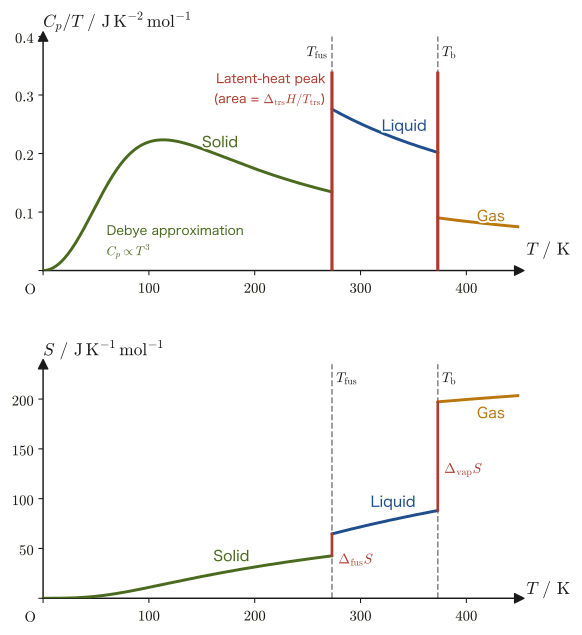
\begin{equation} S(T)=\int_0^T\frac{C_p}{T}\,\dd T\qquad(\text{at constant pressure}) \label{eq:30-S-third-law} \end{equation}Let us confirm two things about this equation. First, as $T\to0$, the quantum nature of lattice vibrations (the Debye approximation) gives $C_p\propto T^3$, so that $C_p/T\propto T^2\to0$, and the integral takes a finite value even though the lower limit of integration is $T=0$ (in metals a term $C_p\propto T$ from the electrons is added, but even then $C_p/T$ is finite and the integral converges). Second, the heat capacity $C_p$ is a positive quantity (adding heat raises the temperature; for the thermodynamic reason, see Section 31.8), so $C_p/T\gt0$, and for $T\gt0$ we always have $S(T)=\int_0^T(C_p/T)\,\dd T\gt0$. We use this fact in Section 30.6.
Note, however, that $C_p/T$ is not a continuous function over the whole range of temperature. Each time a substance melts or vaporizes, latent heat is absorbed at constant temperature (Section 30.2), and the entropy jumps discontinuously (in a step). Therefore, when the temperature range spans the melting temperature $T_{\mathrm{fus}}$ or the boiling point $T_b$, we must split the integral into separate intervals for the calculation and add the jumps at the phase transitions ($\Delta_{\mathrm{trs}}S$ of Section 30.2).
Derivation: Entropy across melting and vaporization
For $T_{\mathrm{fus}}\lt T\lt T_b$ (the temperature range in which the substance remains a liquid after the solid has melted), we split the integral into three parts, namely “solid ($0\to T_{\mathrm{fus}}$),” “the jump at melting,” and “liquid ($T_{\mathrm{fus}}\to T$),” and obtain
\begin{equation} S(T)=\int_0^{T_{\mathrm{fus}}}\frac{C_p^{\text{solid}}}{T}\,\dd T+\frac{\Delta_{\mathrm{fus}}H}{T_{\mathrm{fus}}}+\int_{T_{\mathrm{fus}}}^{T}\frac{C_p^{\text{liquid}}}{T}\,\dd T \label{eq:30-S-piecewise-1} \end{equation}Furthermore, for $T_b\le T$ (the temperature range in which vaporization is complete and the substance is a gas), adding to this the contributions of “the jump at vaporization” and “the gas ($T_b\to T$),” we obtain
\begin{equation} S(T)=\int_0^{T_{\mathrm{fus}}}\frac{C_p^{\text{solid}}}{T}\,\dd T+\frac{\Delta_{\mathrm{fus}}H}{T_{\mathrm{fus}}}+\int_{T_{\mathrm{fus}}}^{T_b}\frac{C_p^{\text{liquid}}}{T}\,\dd T+\frac{\Delta_{\mathrm{vap}}H}{T_b}+\int_{T_b}^{T}\frac{C_p^{\text{gas}}}{T}\,\dd T \label{eq:30-S-piecewise-2} \end{equation}Both Eq. \eqref{eq:30-S-piecewise-1} and Eq. \eqref{eq:30-S-piecewise-2} repeat the same idea: integrate $C_p/T$ over each interval on which it is continuous, and at each discontinuity (a phase-transition point) simply add $\Delta_{\mathrm{trs}}H/T_{\mathrm{trs}}$.
∎
Example 30.3: Entropy change accompanying a temperature change, with the heat capacity at constant pressure taken as constant
$1\ \mathrm{mol}$ of a monatomic ideal gas ($C_p=\tfrac52R$, Chapter 23) was heated at constant pressure from $T_1=298\ \mathrm{K}$ to $T_2=373\ \mathrm{K}$. Assuming that $C_p$ can be regarded as constant over this range, find the entropy change $\Delta S$.
Solution. If $C_p$ is constant, independent of temperature, the integral in Eq. \eqref{eq:30-S-integral} can be evaluated as
$$ \Delta S=\int_{T_1}^{T_2}\frac{C_p}{T}\,\dd T=C_p\int_{T_1}^{T_2}\frac{\dd T}{T}=C_p\left[\ln T\right]_{T_1}^{T_2}=C_p\ln\frac{T_2}{T_1} $$(we used the inverse of the differentiation formula for the logarithmic function, $\displaystyle\int\frac{\dd T}{T}=\ln T+\text{constant}$—see University Mathematics, Section 5.1). Substituting the numerical values gives
$$ \Delta S=\frac52R\ln\frac{373}{298}=\frac52\times8.314\ \mathrm{J/(mol\cdot K)}\times\ln(1.2517)\approx20.79\times0.2245\approx4.67\ \mathrm{J/(mol\cdot K)} $$We can also confirm from the sign of this expression that heating always increases the entropy ($\ln(T_2/T_1)\gt0$).
Example 30.4: Entropy change from ice to water vapor
Under a pressure of $1\ \mathrm{atm}$, $1\ \mathrm{mol}$ of ice was heated from $273.15\ \mathrm{K}$ until it became water vapor at $373.15\ \mathrm{K}$. Taking the enthalpy of fusion to be $\Delta_{\mathrm{fus}}H=6.01\ \mathrm{kJ/mol}$, the enthalpy of vaporization to be $\Delta_{\mathrm{vap}}H=40.66\ \mathrm{kJ/mol}$, and the molar heat capacity at constant pressure of liquid water to be $C_{p,\mathrm{m}}=75.3\ \mathrm{J/(K\cdot mol)}$ (assumed constant, independent of temperature), find the entropy change $\Delta S$.
Solution. We divide the process into three stages: (i) melting at $273.15\ \mathrm{K}$, (ii) heating of liquid water, $273.15\ \mathrm{K}\to373.15\ \mathrm{K}$, and (iii) vaporization at $373.15\ \mathrm{K}$, and add them up using the idea of Eq. \eqref{eq:30-S-piecewise-2}.
$$ \Delta S_{\mathrm{(i)}}=\frac{\Delta_{\mathrm{fus}}H}{T_{\mathrm{fus}}}=\frac{6010\ \mathrm{J/mol}}{273.15\ \mathrm{K}}\approx22.0\ \mathrm{J/(K\cdot mol)} $$ $$ \Delta S_{\mathrm{(ii)}}=\int_{T_{\mathrm{fus}}}^{T_b}\frac{C_{p,\mathrm{m}}}{T}\,\dd T=C_{p,\mathrm{m}}\ln\frac{373.15}{273.15}=75.3\times\ln(1.3661)\approx75.3\times0.3120\approx23.5\ \mathrm{J/(K\cdot mol)} $$ $$ \Delta S_{\mathrm{(iii)}}=\frac{\Delta_{\mathrm{vap}}H}{T_b}=\frac{40660\ \mathrm{J/mol}}{373.15\ \mathrm{K}}\approx109.0\ \mathrm{J/(K\cdot mol)} $$Therefore,
$$ \Delta S=22.0+23.5+109.0\approx154.5\ \mathrm{J/(K\cdot mol)} $$We see that most of the total entropy increase (about $70\ \%$) occurs in the vaporization stage. This corresponds to the fact, in Figure 30.3 (lower panel), that the jump at $T_b$ is much larger than the jump at $T_{\mathrm{fus}}$.
30.4 Introduction of the Helmholtz Free Energy and the Gibbs Energy
The law of entropy increase for an isolated system, $\dd S\ge0$ (Chapter 29), can be used only in the limited situation of “a system that exchanges nothing at all with its surroundings.” In the laboratory, however, we ordinarily deal with systems that exchange heat with their surroundings (and so are not isolated), like a beaker placed in a thermostatic bath. For such systems, too, the Clausius inequality $\dd S\ge\dd'Q/T$ (Chapter 29) itself can be used as it stands—but the heat $\dd'Q$ received by the system remains on the right-hand side, so this alone does not let us “decide whether a change is spontaneous by looking only at the variables of the system.” In this section, under two conditions that are frequently met in the laboratory, we rewrite the Clausius inequality as an inequality involving only state quantities of the system. Note that the $T$ in the Clausius inequality is the temperature of the heat reservoir, and “constant temperature” below means that the temperature of the system is also equal to this reservoir temperature and is kept constant.
30.4.1 Helmholtz free energy — conditions of constant volume and constant temperature
First we consider the case in which the volume is kept constant and no non-expansion work (work other than the work $-p\,\dd V$ that accompanies a change of volume, such as electrical work) acts. Since the volume does not change ($\dd V=0$) and there is no non-expansion work either, the work received by the system is $\dd'W=0$. From the first law of thermodynamics $\dd U=\dd'Q+\dd'W$ (Chapter 23), we obtain
$$ \dd U=\dd'Q\qquad(\text{constant volume, no non-expansion work}) $$Substituting this into the Clausius inequality $\dd S\ge\dd'Q/T$ gives $\dd S\ge\dd U/T$, that is, $T\,\dd S\ge\dd U$, and rearranging, we obtain the inequality
\begin{equation} \dd U-T\,\dd S\le0\qquad(\text{constant volume, no non-expansion work}) \label{eq:30-dU-TdS-ineq} \end{equation}The left-hand side $\dd U-T\,\dd S$ of this inequality is written using only the state quantities $U,T,S$ of the system—note that it makes no reference to the external heat reservoir.
Definition 30.1: Helmholtz (free) energy $A$
\begin{equation} A\equiv U-TS \label{eq:30-A-def} \end{equation}is called the Helmholtz free energy. In physics textbooks it is often written $F$, but in this book we write $A$ (the same symbol $A$ is also used in Part VII, on statistical mechanics). Since $U,T,S$ are all state quantities, $A$ is also a state quantity.
Taking the infinitesimal change of both sides of Eq. \eqref{eq:30-A-def} (using the product rule of differentiation, $\dd(TS)=T\,\dd S+S\,\dd T$), we obtain
\begin{equation} \dd A=\dd U-T\,\dd S-S\,\dd T \label{eq:30-dA-full} \end{equation}This is a relation that holds in general, at all times (we have not yet used the conditions of constant volume and constant temperature here—we have simply differentiated the definition of $A$). If we now add the condition that the temperature is constant ($\dd T=0$), the third term of Eq. \eqref{eq:30-dA-full} vanishes and $\dd A=\dd U-T\,\dd S$. Combining this with Eq. \eqref{eq:30-dU-TdS-ineq} obtained above (the condition of constant volume and no non-expansion work), we obtain the following result.
Law 30.2: Helmholtz free energy as a criterion for spontaneous change
In a change in which the volume and temperature are kept constant and no non-expansion work acts,
\begin{equation} \dd A\le0 \label{eq:30-dA-spontaneous} \end{equation}holds. That is, in a spontaneous change (an irreversible change) under such conditions $A$ necessarily decreases, and in a reversible change (a change extremely close to the equilibrium state) $\dd A=0$. In other words, at constant volume and constant temperature, the system changes spontaneously in the direction in which $A$ decreases, and reaches equilibrium when $A$ is at its minimum.
30.4.2 Gibbs energy — conditions of constant pressure and constant temperature
Next we consider the case in which the pressure is kept constant and no non-expansion work acts. Constant pressure means that the external pressure $p_{\mathrm{ex}}$ and the pressure $p$ of the system are equal to a constant value ($p_{\mathrm{ex}}=p=\text{constant}$). In this case the only work received by the system is expansion work ($\dd'W=-p_{\mathrm{ex}}\dd V=-p\,\dd V$), and from the first law of thermodynamics $\dd'Q=\dd U-\dd'W=\dd U+p\,\dd V$. Since the pressure is constant, we can write $p\,\dd V=\dd(pV)$ (because $\dd p=0$), and so
$$ \dd'Q=\dd U+\dd(pV)=\dd(U+pV)=\dd H\qquad(\text{constant pressure, no non-expansion work}) $$(here we used the definition of the enthalpy, $H\equiv U+pV$, from Chapter 27). Substituting this into the Clausius inequality $\dd S\ge\dd'Q/T$ gives $\dd S\ge\dd H/T$, that is, $T\,\dd S\ge\dd H$, and rearranging,
\begin{equation} \dd H-T\,\dd S\le0\qquad(\text{constant pressure, no non-expansion work}) \label{eq:30-dH-TdS-ineq} \end{equation}is obtained.
Definition 30.2: Gibbs (free) energy $G$
\begin{equation} G\equiv H-TS=U+pV-TS \label{eq:30-G-def} \end{equation}is called the Gibbs energy (also called the Gibbs free energy). Since $H,T,S$ are all state quantities, $G$ is also a state quantity.
By exactly the same procedure as for the Helmholtz free energy, the total differential of Eq. \eqref{eq:30-G-def} is in general
\begin{equation} \dd G=\dd H-T\,\dd S-S\,\dd T \label{eq:30-dG-full} \end{equation}and at constant temperature ($\dd T=0$) this becomes $\dd G=\dd H-T\,\dd S$. Combining this with Eq. \eqref{eq:30-dH-TdS-ineq} (the condition of constant pressure and no non-expansion work), we obtain
Law 30.3: Gibbs energy as a criterion for spontaneous change
In a change in which the pressure and temperature are kept constant and no non-expansion work acts,
\begin{equation} \dd G\le0 \label{eq:30-dG-spontaneous} \end{equation}holds. That is, at constant pressure and constant temperature, the system changes spontaneously in the direction in which $G$ decreases, and reaches equilibrium when $G$ is at its minimum.
Intuition: $\dd G\le0$ is the same statement as “an increase in the total entropy of the system and its surroundings”
At the beginning of this chapter we said that $A$ and $G$ “express the combined effect of the entropy of the system and the entropy of the surroundings using only the variables of the system.” Let us verify this. In a change at constant pressure and constant temperature with no non-expansion work, the surroundings (a heat reservoir at temperature $T$) lose heat equal to the heat $\dd'Q=\dd H$ received by the system; that is, they receive heat $-\dd H$. The entropy change of a heat reservoir at constant temperature is the heat it receives divided by that temperature, so the entropy change of the surroundings is $-\dd H/T$. Therefore the entropy change of the system and surroundings taken together is
$$ \dd S_{\text{total}}=\dd S+\left(-\frac{\dd H}{T}\right)=-\frac{\dd H-T\,\dd S}{T}=-\frac{\dd G}{T} $$Since $T\gt0$, the law of entropy increase for the total entropy, $\dd S_{\text{total}}\ge0$, is exactly the same statement as $\dd G\le0$. Similarly, at constant volume and constant temperature, $\dd S_{\text{total}}=-\dd A/T$.
The origin of the name “free energy” can also be seen from here. Of $U$ or $H$, the $TS$ part is the part that must flow into or out of the surroundings as heat along with the change in entropy, and it is not necessarily freely available as work. The remainder, $A=U-TS$ or $G=H-TS$, corresponds to the “free” part that can be extracted as work (we verify this in Section 30.5).
Intuition: Choosing between $A$ and $G$
$A$ and $G$ are both “the law of entropy increase rewritten in terms of the variables of the system alone,” and their roles are exactly the same—only the conditions they presuppose differ. For a change in a sealed container (whose volume cannot be changed), use $A$; for a change in a container open to atmospheric pressure (the volume can change freely, but the pressure remains at atmospheric pressure), use $G$. Most of the reactions treated in chemistry and materials science are carried out in flasks and beakers left open to the air at a constant temperature (room temperature or the reaction temperature), so $G$, which matches the conditions of constant pressure and constant temperature, is in practice the one used more often.
Example 30.5: Which free energy should be used?
In each of the situations (a) and (b) below, answer whether $A$ or $G$ should be used to determine the direction of spontaneous change. (a) A chemical reaction kept at a constant temperature in a sealed steel pressure vessel with its lid closed (the volume cannot be changed). (b) A neutralization reaction proceeding at room temperature and atmospheric pressure in a beaker open to the air.
Solution. (a) The volume of the pressure vessel is fixed at a constant value ($\dd V=0$), so it satisfies the premises of Law 30.2 (constant volume and constant temperature). Therefore we use $A$, and the reaction proceeds in the direction in which $\dd A\le0$. (b) For a beaker open to the air, the volume can change freely, but the pressure is always kept constant at atmospheric pressure (it is balanced against the atmosphere, a huge “pressure reservoir”). The temperature can also be regarded as constant at room temperature, so the premises of Law 30.3 (constant pressure and constant temperature) are satisfied, and we use $G$: the reaction proceeds in the direction in which $\dd G\le0$. Most reactions in the laboratory are in the situation (b) (open to the air, at constant temperature), and this is why $G$ plays the leading role in chemical thermodynamics.
Example 30.6: At what temperature does ice melt? — The sign of $\Delta G=\Delta H-T\Delta S$
Consider the change in which ice melts to become water at a pressure of $1\ \mathrm{atm}$. Let the enthalpy of fusion be $\Delta_{\mathrm{fus}}H=6.01\ \mathrm{kJ/mol}$ and the melting temperature be $T_{\mathrm{fus}}=273.15\ \mathrm{K}$, and approximate $\Delta_{\mathrm{fus}}H$ and $\Delta_{\mathrm{fus}}S$ as independent of temperature in the temperature range considered. (1) Find $\Delta_{\mathrm{fus}}S$. (2) Calculate $\Delta G=\Delta_{\mathrm{fus}}H-T\Delta_{\mathrm{fus}}S$ at $263.15\ \mathrm{K}$ ($-10\ ^\circ\mathrm{C}$) and at $283.15\ \mathrm{K}$ ($10\ ^\circ\mathrm{C}$), and determine whether the ice melts. (3) Find the temperature at which $\Delta G=0$.
Solution. (1) From Eq. \eqref{eq:30-trs-entropy},
$$ \Delta_{\mathrm{fus}}S=\frac{6010\ \mathrm{J/mol}}{273.15\ \mathrm{K}}\approx22.0\ \mathrm{J/(K\cdot mol)} $$(2) Since this is a change at constant pressure and constant temperature (with no non-expansion work), the change proceeds spontaneously in the direction in which $\Delta G\lt0$ (Law 30.3). At $T=263.15\ \mathrm{K}$,
$$ \Delta G=6010-263.15\times22.0\approx6010-5790\approx+2.2\times10^{2}\ \mathrm{J/mol}\ (\gt0) $$so the ice does not melt (the reverse change, freezing, is spontaneous). At $T=283.15\ \mathrm{K}$,
$$ \Delta G=6010-283.15\times22.0\approx6010-6230\approx-2.2\times10^{2}\ \mathrm{J/mol}\ (\lt0) $$so the ice melts spontaneously.
(3) Solving $\Delta G=\Delta_{\mathrm{fus}}H-T\Delta_{\mathrm{fus}}S=0$ for $T$ gives
$$ T=\frac{\Delta_{\mathrm{fus}}H}{\Delta_{\mathrm{fus}}S}=\frac{6010}{22.0}=273.15\ \mathrm{K} $$which coincides with the melting temperature $T_{\mathrm{fus}}$. At this temperature $\Delta G=0$; that is, ice and water coexist in equilibrium. At low temperatures the $\Delta H$ term (absorbing heat is unfavorable) dominates, and at high temperatures the $-T\Delta S$ term (an increase in disorder is favorable) dominates, so the sign switches. How the stability of phases is examined by focusing on this temperature dependence of $G=H-TS$ can also be confirmed in the gibbs-simulator.
30.5 Maximum Work and Maximum Non-Expansion Work
The Helmholtz free energy $A$ and the Gibbs energy $G$ not only determine the direction of spontaneous change but also answer a question of great importance in engineering: “How much work can be extracted from a system?” In this section we show that the maximum work obtainable from a system in a reversible change is exactly equal to the changes in $A,G$.
30.5.1 Maximum work
We combine two relations: the first law of thermodynamics $\dd U=\dd'Q+\dd'W$ ($\dd'W$ is the work done on the system by the surroundings, following the sign convention of Chapter 23) and the Clausius inequality $\dd S\ge\dd'Q/T$. Rewriting the Clausius inequality in the form $\dd'Q\le T\,\dd S$ and substituting the first law $\dd'Q=\dd U-\dd'W$, we obtain
$$ \dd U-\dd'W\le T\,\dd S $$Adding $\dd'W$ to both sides of this inequality and subtracting $T\,\dd S$ gives $\dd U-T\,\dd S\le\dd'W$, that is (since we are not multiplying by a negative number, the direction of the inequality does not change),
\begin{equation} \dd'W\ge\dd U-T\,\dd S \label{eq:30-work-ineq} \end{equation}where $T$ is the temperature of the heat reservoir. Now we add the condition that the temperature is constant (an isothermal process). Then, by Eq. \eqref{eq:30-dA-full} of Section 30.4 ($\dd A=\dd U-T\,\dd S$ when $\dd T=0$), the right-hand side is exactly equal to $\dd A$.
Law 30.4: Maximum work
In an isothermal change,
\begin{equation} \dd'W\ge\dd A \label{eq:30-max-work} \end{equation}holds, and equality holds only for a reversible change (this corresponds to the fact that equality in the Clausius inequality holds for a reversible change).
Rewriting this in terms of the work $\dd'W'=-\dd'W$ done by the system on the surroundings gives $\dd'W'\le-\dd A$. That is, the work that a system can do on its surroundings isothermally cannot exceed the decrease $-\dd A$ in $A$.
Intuition: Why is it called “maximum work”?
Rewriting Law 30.4 in terms of the work $\dd'W'=-\dd'W$ done by the system on the surroundings gives
$$ \dd'W'\le-\dd A $$The right-hand side $-\dd A$ is the “decrease in $A$,” which takes a positive value when $A$ decreases ($\dd A\lt0$). In other words, the work that the system can do on its surroundings isothermally cannot exceed the decrease in $A$, and equality (the case in which the maximum possible amount of work is extracted) holds only for a reversible change. This is why $-\dd A$ is called the “maximum work (obtainable from the system in an isothermal change).” If the change is carried out irreversibly (abruptly, with friction), the work obtainable for the same change $\dd A$ is always smaller than $-\dd A$—because friction and turbulence dissipate, as heat, part of the energy that could otherwise have been extracted as work.
(Supplement) If we restrict attention to changes in which the system does work on the surroundings ($\dd'W\lt0$) and $A$ decreases ($\dd A\lt0$), both sides of $\dd'W\ge\dd A$ are negative, so in terms of magnitudes we have $\abs{\dd'W}\le\abs{\dd A}$. Conversely, in a change in which work is done on the system by the surroundings and $A$ increases ($\dd A\gt0$), we have $\dd'W\ge\dd A\gt0$, so the work required is at least $\dd A$. For example, when a gas is compressed isothermally, the work required is smallest if the compression is carried out reversibly.
30.5.2 Maximum non-expansion work
The work $\dd'W$ received by the system can be written as the sum of the expansion work $\dd'W_{\text{expansion}}=-p_{\mathrm{ex}}\dd V$ associated with the volume change of the gas ($p_{\mathrm{ex}}$ is the external pressure) and the non-expansion work $\dd'W_{\text{non-expansion}}$, which is all other work:
$$ \dd'W=-p_{\mathrm{ex}}\dd V+\dd'W_{\text{non-expansion}} $$Examples of non-expansion work include the case in which a battery does electrical work on a circuit (in which case the work $\dd'W_{\text{non-expansion}}$ done on the system is negative) and the case in which electrical work is done on the system from outside in electrolysis (positive). A constant-pressure change is one in which the external pressure $p_{\mathrm{ex}}$ and the pressure $p$ of the system are equal to one constant value ($p_{\mathrm{ex}}=p=\text{constant}$). Now, substituting the above $\dd'W$ into Eq. \eqref{eq:30-work-ineq} ($\dd'W\ge\dd U-T\,\dd S$, the general inequality, in which conditions such as constant temperature and constant pressure have not yet been used), we obtain
$$ -p_{\mathrm{ex}}\dd V+\dd'W_{\text{non-expansion}}\ge\dd U-T\,\dd S $$and solving for $\dd'W_{\text{non-expansion}}$ gives
$$ \dd'W_{\text{non-expansion}}\ge\dd U+p_{\mathrm{ex}}\dd V-T\,\dd S $$If we now add the further condition of constant pressure ($p_{\mathrm{ex}}=p=\text{constant}$), then $p\,\dd V=\dd(pV)$ (because $\dd p=0$), so on the right-hand side $\dd U+p\,\dd V=\dd U+\dd(pV)=\dd(U+pV)=\dd H$; and by Eq. \eqref{eq:30-dG-full} of Section 30.4 ($\dd G=\dd H-T\,\dd S$ when $\dd T=0$), the right-hand side as a whole is exactly equal to $\dd G$.
Law 30.5: Maximum non-expansion work
In a change at constant temperature and constant pressure,
\begin{equation} \dd'W_{\text{non-expansion}}\ge\dd G \label{eq:30-max-work-nonexp} \end{equation}holds, and equality holds only for a reversible change. Written in terms of the non-expansion work $\dd'W'_{\text{non-expansion}}=-\dd'W_{\text{non-expansion}}$ done by the system on the surroundings, the same argument as for Law 30.4 gives
$$ \dd'W'_{\text{non-expansion}}\le-\dd G $$That is, $-\dd G$ (the decrease in $G$) is the maximum non-expansion work that can be extracted from the system at constant temperature and pressure.
Example 30.7: Maximum work in the reversible isothermal expansion of an ideal gas
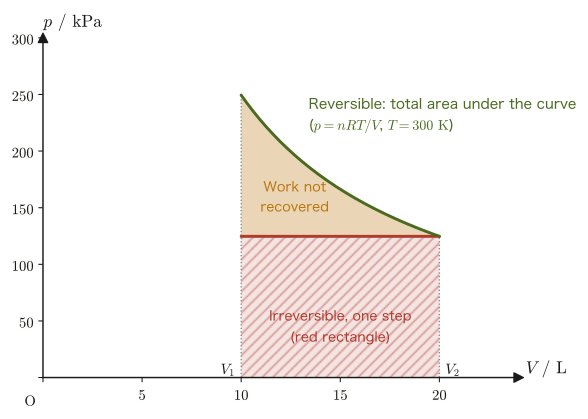
A $1\ \mathrm{mol}$ sample of ideal gas is kept at temperature $T=300\ \mathrm{K}$ while its volume is expanded quasi-statically (reversibly) from $V_1$ to $V_2=2V_1$. Find the work $W'$ done by the system on the surroundings, and verify that it can be written as $W'=-\Delta A$ in terms of the change $\Delta A$ in the Helmholtz free energy (that is, that it is the maximum work).
Solution. Since the process is quasi-static, we may set $p_{\mathrm{ex}}=p$. The work done on the system by the surroundings in a reversible isothermal expansion of an ideal gas is, as found in Chapter 23,
$$ W=-\int_{V_1}^{V_2}p\,\dd V=-nRT\int_{V_1}^{2V_1}\frac{\dd V}{V}=-nRT\ln2 $$ $$ =-1\times8.314\times300\times\ln2\approx-1729\ \mathrm{J} $$Therefore, the work done by the system on the surroundings is $W'=-W=nRT\ln2\approx+1729\ \mathrm{J}$ ($W$ is negative because the system did not have work done on it by the surroundings but instead did work on the surroundings).
On the other hand, since the process is isothermal, the internal energy of an ideal gas does not change ($\Delta U=0$), and from the definition of the Helmholtz free energy, $A=U-TS$ (Eq. \eqref{eq:30-A-def}), with $T$ constant we have $\Delta A=\Delta U-T\Delta S=-T\Delta S$. Using the entropy change $\Delta S=nR\ln(V_2/V_1)=nR\ln2$ for the isothermal expansion of an ideal gas found in Chapter 29, we obtain
$$ \Delta A=-T\Delta S=-nRT\ln2\approx-1729\ \mathrm{J} $$Hence $W=\Delta A$, that is, $W'=-\Delta A$, is confirmed (since the change is reversible, the equality in Eq. \eqref{eq:30-max-work} holds). The work $W'\approx1729\ \mathrm{J}$ done by the system on the surroundings in this reversible expansion is the maximum work that can be extracted at this temperature and for this change in volume. If the same volume change is instead carried out as an irreversible expansion in which the external pressure is suddenly lowered to the final pressure $p_2=nRT/V_2$ and the gas expands in a single step, the work that can be extracted is smaller, $p_2(V_2-V_1)=nRT/2\approx1247\ \mathrm{J}$ (Figure 30.4).
Application: Fuel cells and maximum non-expansion work
The reaction $\mathrm{H_2}+\tfrac12\mathrm{O_2}\to\mathrm{H_2O(l)}$, in which water forms from hydrogen and oxygen, is a spontaneous reaction that is accompanied, at $298\ \mathrm{K}$, by a standard Gibbs energy change $\Delta G^\circ\approx-237.1\ \mathrm{kJ/mol}$ (the “$^\circ$” in $\Delta G^\circ$ indicates that this is the value in the standard state, for example at a pressure of $1\ \mathrm{bar}$). If this reaction is carried out as ordinary combustion, the energy is released only as heat; in a fuel cell, however, the reaction is made to proceed electrochemically (as oxidation and reduction reactions at the electrodes), so that the energy is extracted as non-expansion work—that is, electrical work. By Law 30.5, if the cell could be operated reversibly (ideally, keeping the current extremely small), the maximum electrical work obtainable per $1\ \mathrm{mol}$ of hydrogen is $-\Delta G^\circ\approx237.1\ \mathrm{kJ}$.
Let us convert this into a voltage. When $1\ \mathrm{mol}$ of hydrogen reacts, $n=2\ \mathrm{mol}$ of electrons pass through the external circuit between the electrodes. The magnitude of the electric charge of $1\ \mathrm{mol}$ of electrons is the Faraday constant $F=N_{\mathrm{A}}e\approx96485\ \mathrm{C/mol}$, so the electrical work at a potential difference (electromotive force, emf) $E$ is $nFE$. Setting this equal to the maximum non-expansion work $-\Delta G^\circ$, we obtain
$$ nFE=-\Delta G^\circ\quad\Longrightarrow\quad E=\frac{-\Delta G^\circ}{nF}=\frac{237.1\times10^{3}\ \mathrm{J/mol}}{2\times96485\ \mathrm{C/mol}}\approx1.23\ \mathrm{V} $$The unit is $\mathrm{J/C}=\mathrm{V}$. This is the theoretical electromotive force of a hydrogen fuel cell. In an actual fuel cell, because of the extra voltage required to drive the electrode reactions (the overpotential) and the irreversibility caused by internal resistance, the voltage and the work that can be extracted are smaller than this.
30.6 Temperature Dependence of the Gibbs Energy and the Gibbs–Helmholtz Equation
If we investigate how the Gibbs energy $G$ varies with temperature and pressure, we can discuss how chemical reactions and phase transitions are affected by temperature and pressure. The starting point is the following relation.
Derivation: $\dd G=-S\,\dd T+V\,\dd p$
Take the total differential of the definition $G=U+pV-TS$ (Eq. \eqref{eq:30-G-def}). Using the product rule of differentiation, $\dd(pV)=p\,\dd V+V\,\dd p$ and $\dd(TS)=T\,\dd S+S\,\dd T$, we obtain
$$ \dd G=\dd U+p\,\dd V+V\,\dd p-T\,\dd S-S\,\dd T $$On the other hand, in a quasi-static (reversible) change, the heat is $\dd'Q=T\,\dd S$ (the definition of entropy) and the work done on the system is $\dd'W=-p\,\dd V$, so the first law $\dd U=\dd'Q+\dd'W$ can be written as
$$ \dd U=T\,\dd S-p\,\dd V $$Substituting this into the equation above, $p\,\dd V$ and $T\,\dd S$ cancel each other, and we obtain
\begin{equation} \dd G=-S\,\dd T+V\,\dd p \label{eq:30-dG-Tp} \end{equation}Since $G$ is a state quantity, the difference in $G$ between two equilibrium states, $\Delta G$, is found by integrating this equation along a reversible path, and its value remains the same even when the two states are connected by an irreversible change. Checking the units of the terms on the right-hand side, $S\,\dd T$ has units $\mathrm{J/K}\times\mathrm{K}=\mathrm{J}$ and $V\,\dd p$ has units $\mathrm{m^3}\times\mathrm{Pa}=\mathrm{J}$, which agree with those of $\dd G$ (energy) on the left-hand side.
∎
In the next chapter, we will find similar total differentials for $U$, $H$, and $A$ as well, and survey the four state quantities at once (Section 31.4).
Math Tool: Partial derivatives and subscripts
$G$ is a function $G(T,p)$ of two variables, the temperature $T$ and the pressure $p$. The expression $\left(\pdiff{G}{T}\right)_p$ (read “partial G partial T, $p$ constant”) is to be understood as follows. In $\pdiff{}{T}$, the symbol $\partial$ (read “round” in Japanese) denotes partial differentiation, “differentiate with respect to that variable alone, holding the other variables fixed,” and the subscript $p$ outside the parentheses means “regard the pressure $p$ as a constant.” In other words, it expresses the rate at which $G$ increases when the temperature is raised slightly while the pressure is kept constant (the coefficient obtained by differentiating with respect to $T$). The definition of the partial derivative and the formula for the total differential were studied in University Mathematics, Section 6.2.
Eq. \eqref{eq:30-dG-Tp} shows that $G$ can be regarded as a function $G=G(T,p)$ of the temperature $T$ and the pressure $p$. The general formula for the total differential of a function of two variables (University Mathematics, Section 6.2) is
$$ \dd G=\left(\pdiff{G}{T}\right)_p\dd T+\left(\pdiff{G}{p}\right)_T\dd p $$and comparing the coefficients with those of Eq. \eqref{eq:30-dG-Tp}, we can read off the following relations.
Theorem 30.3: Partial-derivative expressions for the Gibbs energy
\begin{equation} \left(\pdiff{G}{T}\right)_p=-S,\qquad\qquad \left(\pdiff{G}{p}\right)_T=V \label{eq:30-G-partials} \end{equation}Caution: The subscript of the partial derivative is $p$ (not $V$)
Since $G$ is a function of $T$ and $p$, as in Eq. \eqref{eq:30-dG-Tp}, the pressure $p$ is held constant in the partial derivative with respect to temperature: $\left(\pdiff{G}{T}\right)_p$. The second term of the total differential is likewise not $\dd V$ but $\left(\pdiff{G}{p}\right)_T\dd p$.
Intuition: The meaning of the two partial derivatives
Let us consider the meaning of $\left(\pdiff{G}{T}\right)_p=-S$. The entropy $S$ is, for any substance (except in the special case of absolute zero), always a positive quantity (in Section 30.3 we saw that, from $C_p\gt0$ and $S(0)=0$, for $T\gt0$ we have $S(T)=\int_0^T(C_p/T)\,\dd T\gt0$). Therefore,
$$ \left(\pdiff{G}{T}\right)_p\lt0 $$holds at all times—if the temperature is raised while the pressure is kept constant, the Gibbs energy always decreases. Moreover, we can read off that the larger $S$ is for a substance (a gas, for example, has far greater entropy than a liquid or a solid), the more steeply $G$ decreases as the temperature rises. The meaning of $\left(\pdiff{G}{p}\right)_T=V$ is that if the pressure is raised by $\dd p$ while the temperature is kept constant, $G$ increases by $V\,\dd p$ ($V$ is always positive).
So far we have obtained the temperature dependence of $G$, $\left(\pdiff{G}{T}\right)_p=-S$, but measuring the entropy $S$ directly in an experiment is not easy. We therefore derive a relation—the Gibbs–Helmholtz equation—that connects the temperature dependence of $G$ with the enthalpy $H$, which is easier to measure directly. If we measure how the Gibbs energy change $\Delta G$ of a chemical reaction varies with temperature, we can use this equation to find the heat of reaction $\Delta H$.
Derivation: The Gibbs–Helmholtz equation (first form)
Consider partially differentiating the quantity $G/T$ with respect to the temperature $T$ at constant pressure. Using the quotient rule ($\left(\dfrac{f}{g}\right)'=\dfrac{f'g-fg'}{g^2}$; here $f=G,g=T$), we obtain
$$ \left(\pdiff{}{T}\frac{G}{T}\right)_p=\frac{1}{T}\left(\pdiff{G}{T}\right)_p-\frac{G}{T^2}=\frac{1}{T}\left\{\left(\pdiff{G}{T}\right)_p-\frac{G}{T}\right\} $$Here we substitute $\left(\pdiff{G}{T}\right)_p=-S$ from Eq. \eqref{eq:30-G-partials}, together with the relation obtained by solving the definition of $G$, $G=H-TS$, for $S$, namely $S=(H-G)/T$, and obtain
$$ \left(\pdiff{}{T}\frac{G}{T}\right)_p=\frac{1}{T}\left(-S-\frac{G}{T}\right)=-\frac{1}{T}\left(\frac{H-G}{T}+\frac{G}{T}\right)=-\frac{1}{T}\cdot\frac{H}{T}=-\frac{H}{T^2} $$(Note that $\dfrac{H-G}{T}+\dfrac{G}{T}=\dfrac{H-G+G}{T}=\dfrac{H}{T}$, since $-G$ and $+G$ in the numerator cancel each other.)
∎
Formula 30.1: The Gibbs–Helmholtz equation (first form)
\begin{equation} \left(\pdiff{}{T}\frac{G}{T}\right)_p=-\frac{H}{T^2} \label{eq:30-GH-1} \end{equation}Derivation: The Gibbs–Helmholtz equation (second form) — replacing the variable by $1/T$
We rewrite Eq. \eqref{eq:30-GH-1} in a form in which, instead of $T$, $1/T$ is regarded as the independent variable. The symbol $\pdiff{}{(1/T)}$ means that $1/T$ is regarded as a single variable $x$ and differentiated with respect to $x$ (with $p$ held constant). Setting $x\equiv1/T$, we have $\dfrac{\dd x}{\dd T}=-\dfrac{1}{T^2}$; that is, from the derivative of the inverse function (or, more simply, by differentiating $x=1/T\Rightarrow T=1/x$ with respect to $x$), $\dfrac{\dd T}{\dd x}=-T^2$. By the partial-derivative formula for composite functions (the chain rule, University Mathematics, Section 6.4), partially differentiating $G/T$ with respect to $x=1/T$ (holding the pressure $p$ constant) gives
$$ \left(\pdiff{}{(1/T)}\frac{G}{T}\right)_p=\left(\pdiff{}{T}\frac{G}{T}\right)_p\cdot\pdiff{T}{(1/T)}=\left(\pdiff{}{T}\frac{G}{T}\right)_p\times(-T^2) $$Substituting $\left(\pdiff{}{T}\dfrac{G}{T}\right)_p=-\dfrac{H}{T^2}$ from Eq. \eqref{eq:30-GH-1} here, we obtain
$$ \left(\pdiff{}{(1/T)}\frac{G}{T}\right)_p=\left(-\frac{H}{T^2}\right)\times(-T^2)=H $$(Checking the units, the left-hand side is $(\mathrm{J/K})\big/(1/\mathrm{K})=\mathrm{J}$, which agrees with the unit of the enthalpy on the right-hand side.)
∎
Formula 30.2: The Gibbs–Helmholtz equation (second form)
\begin{equation} \left(\pdiff{}{(1/T)}\frac{G}{T}\right)_p=H \label{eq:30-GH-2} \end{equation}Why is this formula convenient?
Formula 30.2 means that “if we draw a graph with $G/T$ on the vertical axis and $1/T$ on the horizontal axis, its slope equals the enthalpy $H$ (for a reaction, the heat of reaction $\Delta H$).” If the Gibbs energy change $\Delta G$ of a chemical reaction can be measured or calculated at several different temperatures, then simply by plotting $\Delta G/T$ against $1/T$ and reading off the slope of the straight line, we can find the heat of reaction $\Delta H$ without directly measuring the enthalpy change itself—a practical relation used frequently in chemical thermodynamics.
Example 30.8: Estimating a heat of reaction with the Gibbs–Helmholtz equation
The Gibbs energy change $\Delta G$ of a certain reaction was measured at two temperatures, with the following results: at $T_1=298\ \mathrm{K}$, $\Delta G_1=-20.20\ \mathrm{kJ/mol}$; at $T_2=350\ \mathrm{K}$, $\Delta G_2=-15.00\ \mathrm{kJ/mol}$. Assuming that $\Delta H,\Delta S$ can be regarded as independent of temperature over this range, estimate the heat of reaction $\Delta H$ using (the finite-difference approximation of) Formula 30.2.
Solution. If $\Delta H,\Delta S$ are constant, we can write $\Delta G(T)=\Delta H-T\Delta S$, so $\Delta G/T=\Delta H/T-\Delta S$ is a linear function of $1/T$, and, just as Formula 30.2 says, the slope of the plot of $\Delta G/T$ against $1/T$ is exactly $\Delta H$. Computing the slope from the two data points, we obtain
$$ \frac{\Delta G_1}{T_1}=\frac{-20.20\times10^3}{298}\approx-67.79\ \mathrm{J/(mol\cdot K)},\qquad \frac{\Delta G_2}{T_2}=\frac{-15.00\times10^3}{350}\approx-42.86\ \mathrm{J/(mol\cdot K)} $$ $$ \frac{1}{T_1}\approx3.356\times10^{-3}\ \mathrm{K^{-1}},\qquad\frac{1}{T_2}\approx2.857\times10^{-3}\ \mathrm{K^{-1}} $$ $$ \Delta H\approx\frac{\Delta G_2/T_2-\Delta G_1/T_1}{1/T_2-1/T_1}=\frac{-42.86-(-67.79)}{(2.857-3.356)\times10^{-3}}=\frac{24.93}{-0.499\times10^{-3}}\approx-5.00\times10^4\ \mathrm{J/mol}=-50.0\ \mathrm{kJ/mol} $$(The data were originally back-calculated from the line $\Delta G=\Delta H-T\Delta S$ with $\Delta H=-50.0\ \mathrm{kJ/mol}$ and $\Delta S=-100\ \mathrm{J/(mol\cdot K)}$, and we can confirm that the slope obtained from just two points agrees exactly with the original $\Delta H=-50.0\ \mathrm{kJ/mol}$. In an actual measurement, one finds the slope of the line not from two points alone but from many temperature points by the method of least squares, and also checks whether $\Delta H,\Delta S$ really are independent of temperature.)
In this chapter, four state quantities have appeared: the internal energy $U$, the enthalpy $H=U+pV$, the Helmholtz free energy $A=U-TS$, and the Gibbs energy $G=H-TS=U+pV-TS$. These are not unrelated quantities: starting from $U$, they form one connected family generated by combining two kinds of operations, “replacing the volume $V$ by the pressure $p$” and “replacing the entropy $S$ by the temperature $T$” (Figure 30.5). The mathematical nature of this “replacement of variables” (the Legendre transformation) and the way of treating the four state quantities in a unified manner will be studied in detail in the next chapter.
30.7 Summary and Exercises
30.7.1 Summary
- From the Clausius inequality $\dd S\ge\dd'Q/T$ and the law of entropy increase for an isolated system, heat always flows from high temperature to low temperature (Eq. \eqref{eq:30-heat-direction}).
- A phase transition (melting, vaporization) proceeds at constant temperature, so its entropy change equals the heat of the phase transition $\Delta_{\mathrm{trs}}H$ divided by the phase-transition temperature $T_{\mathrm{trs}}$: $\Delta_{\mathrm{trs}}S=\Delta_{\mathrm{trs}}H/T_{\mathrm{trs}}$ (Eq. \eqref{eq:30-trs-entropy}). For the reverse transitions (freezing, condensation) the sign is reversed. By Trouton's rule, the entropy of vaporization is almost constant, independent of the substance (about $85\ \mathrm{J/(K\cdot mol)}$).
- When the temperature changes at constant pressure, the entropy change is $S(T_2)=S(T_1)+\int_{T_1}^{T_2}(C_p/T)\,\dd T$ (Eq. \eqref{eq:30-S-integral}). If we accept the third law of thermodynamics ($S(0)=0$ for a perfect crystal, Law 30.1), we can define the absolute entropy $S(T)$ measured from absolute zero (Eq. \eqref{eq:30-S-third-law}).
- For systems other than isolated ones, the direction of spontaneous change is judged by the decrease $\dd A\le0$ (Law 30.2) of the Helmholtz free energy $A=U-TS$ (Eq. \eqref{eq:30-A-def}) at constant volume and constant temperature with no non-expansion work, and by the decrease $\dd G\le0$ (Law 30.3) of the Gibbs energy $G=H-TS$ (Eq. \eqref{eq:30-G-def}) at constant pressure and constant temperature with no non-expansion work. This is the same statement as the increase of the total entropy of the system and its surroundings together, $\dd S_{\text{total}}=-\dd G/T\ge0$ (or $-\dd A/T$ in the case of $A$).
- In an isothermal change, the work $W'$ that the system does on its surroundings cannot exceed the decrease $-\Delta A$ of $A$ (maximum work, Law 30.4), and, if we consider only non-expansion work, that work cannot exceed the decrease $-\Delta G$ of $G$ (Law 30.5). In both cases, equality holds only for a reversible change.
- The total differential of the Gibbs energy is $\dd G=-S\,\dd T+V\,\dd p$ (Eq. \eqref{eq:30-dG-Tp}), and its temperature dependence is $(\partial G/\partial T)_p=-S\lt0$ (Eq. \eqref{eq:30-G-partials}). By the Gibbs–Helmholtz equation (first form $(\partial(G/T)/\partial T)_p=-H/T^2$, second form $(\partial(G/T)/\partial(1/T))_p=H$, Eqs. \eqref{eq:30-GH-1} and \eqref{eq:30-GH-2}), the enthalpy (heat of reaction) $H$ can be found from the temperature dependence of $G/T$.
Related simulators: Gibbs Free Energy and Phases (you can check which of ice, water, and water vapor is stable from the temperature dependence of the Gibbs energy $G=H-TS$ of this chapter), Entropy of Mixing (you can check that the direction of mixing when the partition is removed is determined both by the increase of entropy and by the decrease of $G$ at constant pressure), Entropy and Free Energy (builds the entropy of mixing from the partition function and calculates the switching among ice, water, and water vapor using $G=H-TS$; it lets you look again at the content of this chapter from the standpoint of statistical mechanics).
From this chapter to the next
The four state quantities $U,H,A,G$ that appeared in this chapter are all “state quantities with the dimension of energy,” and yet they are connected to one another by their definitions ($H=U+pV$, $A=U-TS$, $G=H-TS$). In the next chapter (Chapter 31), we survey all four at once and, from their total differentials, derive the Maxwell relations, which connect quantities that are easy to measure in the laboratory—the relation $\dd G=-S\,\dd T+V\,\dd p$ that we derived in this chapter is also organized in the next chapter, together with the total differentials of $U,H,A$, and from these the relations are then derived using Schwarz's theorem.
30.7.2 Exercises
Exercise 30.1: Direction of heat transfer and the law of entropy increase
A quantity of heat $Q=500\ \mathrm{J}$ was transferred from a body at temperature $T_2=350\ \mathrm{K}$ to a body at temperature $T_1=300\ \mathrm{K}$. (1) Find the entropy change of each of the two bodies and the entropy change of the whole. (2) If the same quantity of heat were transferred in the opposite direction (from the $300\ \mathrm{K}$ body to the $350\ \mathrm{K}$ body), what would the total entropy change be? (3) To which statement of the second law of thermodynamics does this correspond?
Hint: Note that the whole system consisting of the hot and the cold body together is an isolated system, and retrace Eq. \eqref{eq:30-heat-direction-ineq} of Section 30.1.
Exercise 30.2: The meaning of the discontinuous jumps in the $C_p/T$–$T$ graph
In the $C_p/T$–$T$ graph of Figure 30.3, explain what the steps and peaks that appear at the melting point $T_{\mathrm{fus}}$ and the boiling point $T_b$ mean physically. Also state how they appear in the $S$–$T$ graph of the same figure.
Hint: Recall that $(\partial S/\partial T)_p=C_p/T$, and that in a phase transition only heat (latent heat) flows in or out while the temperature does not change.
Exercise 30.3: Entropy change in heating and vaporizing water
Under a pressure of $1\ \mathrm{atm}$, $1\ \mathrm{mol}$ of liquid water is heated from $298.15\ \mathrm{K}$ to $373.15\ \mathrm{K}$ and then entirely turned into water vapor at $373.15\ \mathrm{K}$. Take the molar heat capacity at constant pressure of liquid water to be $C_{p,\mathrm{m}}=75.3\ \mathrm{J/(K\cdot mol)}$ (constant) and the enthalpy of vaporization to be $\Delta_{\mathrm{vap}}H=40.66\ \mathrm{kJ/mol}$. Find the entropy change in (1) the heating stage, (2) the vaporization stage, and (3) the whole process.
Hint: Use Eq. \eqref{eq:30-S-integral} for the heating stage and Eq. \eqref{eq:30-trs-entropy} for the vaporization stage. The idea is the same as in Example 30.4.
Exercise 30.4: Why the Helmholtz free energy $A$ is the criterion for spontaneous change
Explain why the Helmholtz free energy $A$ is “the criterion for spontaneous change at constant volume and constant temperature (with no non-expansion work),” by following the derivation (Section 30.4) that leads to $\dd A=\dd U-T\,\dd S\le0$ (Eq. \eqref{eq:30-dA-spontaneous}).
Hint: Consider separately which part of the Clausius inequality uses the condition “constant volume and no non-expansion work,” and which part of the definition of $A$ uses the condition “constant temperature.”
Exercise 30.5: Work required for isothermal compression and $\Delta A$
$1\ \mathrm{mol}$ of an ideal gas is compressed isothermally from volume $V_1$ to $V_1/2$ in a thermostatic bath at $300\ \mathrm{K}$. (1) For quasi-static (reversible) compression, find the work $W$ done on the system and $\Delta A$. (2) When the external pressure is suddenly set to $p_{\mathrm{ex}}=2p_1$ ($p_1$ is the initial pressure) and the gas is compressed in one step, find the work $W$ done on the system, and verify, by comparing with (1), that $W\ge\Delta A$ (Law 30.4) holds. (3) For the change in (2), find the total entropy change of the system and the thermostatic bath (the surroundings) together.
Hint: Since the process is isothermal, $\Delta U=0$ for an ideal gas, that is, $Q=-W$. The heat received by the thermostatic bath is $-Q$, and its entropy change is $(-Q)/T$.
Exercise 30.6: The sign of the temperature dependence of the Gibbs energy
Explain why the temperature dependence of the Gibbs energy, $(\partial G/\partial T)_p=-S$ (Eq. \eqref{eq:30-G-partials}), is always negative for any substance under any conditions. Also answer, together with the reason, which of a gas, a liquid, and a solid shows the steepest decrease of $G$ as the temperature rises.
Hint: The sign of the entropy $S$ is determined by the discussion following Eq. \eqref{eq:30-S-third-law} in Section 30.3. For the relative magnitudes of the entropies of gases, liquids, and solids, recall the numerical value of the entropy of vaporization in Section 30.2.
Exercise 30.7: The Daniell cell and the maximum electrical work
The standard electromotive force of the Daniell cell ($\mathrm{Zn}+\mathrm{Cu^{2+}}\to\mathrm{Zn^{2+}}+\mathrm{Cu}$) is $E^\circ=1.10\ \mathrm{V}$, and the electrons involved in the reaction amount to $n=2\ \mathrm{mol}$ per $1\ \mathrm{mol}$ of $\mathrm{Zn}$. Take the Faraday constant to be $F=96485\ \mathrm{C/mol}$. (1) Find the standard Gibbs energy change $\Delta G^\circ$ of this reaction. (2) Find the maximum electrical work that can be extracted when $1.00\ \mathrm{g}$ of zinc (molar mass $65.38\ \mathrm{g/mol}$) reacts.
Hint: As we saw in the application to fuel cells, the maximum electrical work that can be extracted is $nFE=-\Delta G^\circ$ (Law 30.5).
Exercise 30.8: Temperature range in which a reaction proceeds spontaneously
For a certain reaction (at constant pressure), $\Delta H=-50\ \mathrm{kJ/mol}$ and $\Delta S=-100\ \mathrm{J/(K\cdot mol)}$. Assuming that $\Delta H,\Delta S$ are independent of temperature, find the temperature range in which this reaction proceeds spontaneously. Explain, in terms of the roles of the two terms of $\Delta G=\Delta H-T\Delta S$, why the reaction fails to proceed at high temperatures even though $\Delta H\lt0$.
Hint: By Law 30.3, the reaction proceeds in the direction in which $\Delta G\lt0$. Find the temperature at which $\Delta G=0$, using the same idea as in the melting of ice in Example 30.6.
30.7.3 References
- Yasuhide Mochizuki, Physics Notes: Thermodynamics (handwritten lecture notes, in Japanese). The source of this chapter (pp. 50–54).
- P. Atkins, J. de Paula and J. Keeler, Atkins' Physical Chemistry, 11th ed., Oxford University Press, 2018.
- H. B. Callen, Thermodynamics and an Introduction to Thermostatistics, 2nd ed., John Wiley & Sons, 1985.
- Hal Tasaki, Thermodynamics — From a Modern Perspective (New Physics Series; in Japanese), Baifukan, 2000.